
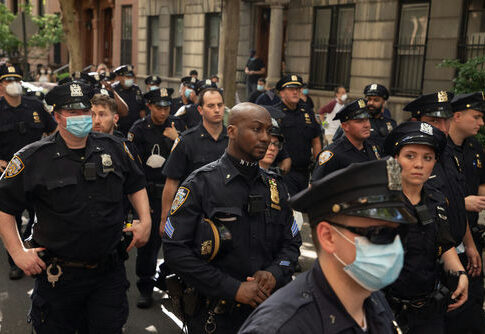
When armed gay cops are told they are good enough to guard Pride but not welcome to march in it, many Americans see one more sign that the rules are written by elites who talk about “inclusion” while deepening the divides they claim to heal.
Story Snapshot
- The New York City Pride March still bans uniformed, armed police contingents, including the Gay Officers Action League.
- NYPD Commissioner Jessica Tisch calls the policy “hypocrisy,” saying Pride wants armed protection but rejects armed LGBTQ officers.[1]
- Organizers insist it is a universal no-weapons rule born from trauma and distrust of police, not discrimination.[1]
- The fight exposes wider frustration that powerful institutions use “safety” and “inclusion” language while ignoring everyday people’s concerns.[17]
Commissioner Tisch’s Charge of Hypocrisy
Police Commissioner Jessica Tisch sent a sharply worded letter to Heritage of Pride, the group that runs New York City’s Pride March, after it again barred the New York Police Department’s Gay Officers Action League from marching in full uniform with their service weapons.[1] In her letter, she branded the decision “hypocrisy,” arguing that organizers want “thousands of armed, uniformed police officers” guarding the event while excluding the very LGBTQ officers who serve that community.[1] Her message tapped into a broader anger that those in charge enjoy police protection yet shame the people who provide it.
Commissioner Tisch also stressed that New York Police Department policy requires any officer in uniform to carry a service weapon for both public and personal safety.[5] From her view, Heritage of Pride is effectively telling gay and transgender officers they must either hide who they are or stay out of sight, because they cannot both follow department safety rules and be fully visible in the march.[5] That tension feels familiar to many Americans who see government employees forced to choose between their identity, their job rules, and shifting political demands from activist boards.
Heritage of Pride’s No-Weapons Policy and Its Roots
Heritage of Pride leaders say the decision is not about sexual orientation or gender identity, but about a strict, across-the-board rule: no contingent may march with weapons.[1] A spokesman, Chris Piedmont, explained that all groups are subject to the same guideline and that Gay Officers Action League members “are welcome to march without weapons like every other contingent.”[1] Pride organizers tie this policy to the legacy of police violence against queer and transgender people, especially people of color, and to pain that resurfaced after the murder of George Floyd.[6][20] For many activists, seeing guns and uniforms inside Pride feels like opening old wounds, even when the people wearing those uniforms are themselves LGBTQ.
The ban on police groups at New York Pride first appeared in 2021 and was announced to last until at least 2025.[6][7] Organizers said they wanted to reduce the official police role and send a message that Pride is a protest as much as a party, built on resistance to past raids and abuse.[6][20] Supporters of the ban argue that limiting armed, uniformed presence inside the march helps some vulnerable marchers feel safer, even if uniformed officers still line the route for crowd control.[6] Critics respond that this creates a split reality: police are “necessary” on the edges when things go wrong, but “unwelcome” at the center when institutions want to signal virtue.
LGBTQ Officers Caught Between Two Systems
LGBTQ officers in the Gay Officers Action League say they feel singled out in a way that straight colleagues do not.[2] Detective Brian Downey, the highest-ranking openly LGBTQ member of the New York Police Department, called it hypocritical that Pride wants police protection yet will not let his group march openly as a unit.[2] When gay officers stand armed on the sidewalk to protect the crowd but cannot join that same crowd in uniform, they see a message that their service is acceptable only when they are invisible.[3] Many workers in other fields relate to this pattern: institutions celebrate diversity in speeches while keeping diverse employees away from the spotlight when tensions rise.
This clash is not unique to New York City. Across the country, marches and parades have fought over whether uniformed police, especially armed ones, belong inside Pride events.[14] Surveys show LGBTQ adults split almost down the middle over police participation: about half support having officers there, almost one-fifth oppose it, and many feel torn.[17] Younger, queer, transgender, and nonbinary people are more likely to oppose police presence, while older and more established LGBTQ adults are more likely to back it.[17] That divide reflects a deeper question: does change come from working inside the system or by keeping the system at arm’s length?
Elites, Safety Language, and Public Frustration
For many conservatives and liberals alike, this story fits a broader pattern where powerful boards and agencies use the language of “safety,” “trauma,” and “inclusion” to justify decisions that look inconsistent or self-serving. Pride organizers say banning weapons in the march protects the community, yet they still rely on armed officers, barriers, and security plans written with city hall to handle threats outside the march.[1][6] Commissioner Tisch, in turn, defends an internal rule that uniforms must come with guns, even though many Americans question why so many public spaces now depend on armed force.[5] Each side claims the mantle of safety, but neither fully answers who sets the rules or who is held accountable when those rules leave some people stuck in the middle.
The standoff between Heritage of Pride and Gay Officers Action League has become one more flashpoint feeding the belief that a small circle of activists, bureaucrats, and political leaders decides which voices count. Pride boards choose which parts of the police force are “acceptable” at their event, while top police officials choose which internal rules are “non-negotiable,” and ordinary officers and marchers live with the fallout.[1][5] Many Americans watching from the sidelines see a familiar story: institutions talking a big game about inclusion and public safety, yet making choices that suggest image and control matter more than serving real people who just want to live, work, and celebrate in peace.
Sources:
[1] Web – NYPD commish stands with armed gay cops on sidelines of NYC Pride …
[2] Web – NYPD commissioner slams NYC Pride ban on officers as ‘hypocrisy’
[3] Web – NYPD commish walks with armed gay cops in Queens Pride parade …
[5] Web – On Tuesday, @GOALny held a Pride event at One Police Plaza …
[6] Web – The NYPD is furious that the Gay Officers Action League is not …
[7] YouTube – LGBTQ+ NYPD officer group wants to participate in Pride …
[14] Web – Heritage of Pride criticized for excluding NYPD from Pride parade
[17] YouTube – Transgender SFPD officer stands with police against SF Pride’s ban …
[20] Web – Police Participation In Pride – Out To Protect Incorporated