
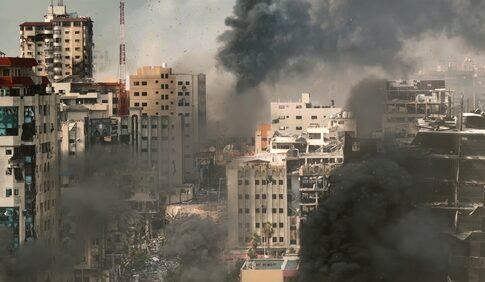
Russia’s latest mass airstrike on Kyiv turned apartment blocks into battlefields, underscoring how high-tech war keeps slaughtering ordinary people while world leaders argue and civilians pay the price.
Story Snapshot
- Russian forces launched one of the largest aerial attacks of the war, sending dozens of missiles and hundreds of drones across Ukraine and into Kyiv.
- Civilian homes and basic infrastructure in at least eight districts of Kyiv were hit, leaving many dead and more than a hundred injured.
- The strike fits a wider pattern of Russia using huge, layered salvos to wear down Ukraine’s air defenses and pressure its society.
- Confusing casualty counts and clashing official stories highlight how hard it is for citizens to get clear truth in modern war.
What Happened In The Latest Kyiv Strike
Russian forces launched a massive overnight air attack on Kyiv and other Ukrainian cities, firing about 73 missiles and 656 drones across the country, according to Ukraine’s air force. The Associated Press video report says at least 18 civilians were killed and 131 injured in the wave of strikes, making this one of the deadliest recent attacks. The salvos hit key cities including Kyiv, Dnipro, Poltava, Kharkiv, and Zaporizhzhia, turning a regular weeknight into a city-wide emergency as sirens sounded for hours.
Officials and reporters say residential buildings and other civilian infrastructure were damaged in eight districts of Kyiv. Video from the city shows smoke rising from burned-out apartment blocks and firefighters battling blazes in the dark. Rescue crews worked through the night to pull survivors from rubble while the air raid alert stayed active, forcing people to choose between hiding from more strikes and risking danger to reach hospitals and shelters. This mix of fear, chaos, and slow rescue work has become grimly familiar for Kyiv residents.
Kyiv Is Living Under Routine Aerial Terror
These strikes are not a one-time event; they fit a well-documented pattern of Russia pounding Kyiv with drones and missiles since 2022. A detailed record of attacks on the capital shows over 1,300 drone and more than 250 missile strikes in 2024 alone, along with 500 air raid alerts and hundreds of damaged homes. Between February 2022 and May 2023, Kyiv’s sirens were active for 887 hours—over a month of collective time when families had to shelter and hope they survived. This latest assault is one more spike in a long, grinding campaign.
Independent analysis of Russian tactics finds that Moscow now uses “layered” strikes: decoy unmanned aircraft trigger Ukrainian air defenses, then larger waves of strike drones and missiles follow. In April 2026, Russia launched over 6,500 Shahed-type unmanned aircraft in one month, averaging 219 unmanned aircraft per day against Ukraine. These numbers show a clear shift toward large-scale, complex attacks meant to exhaust air defenses and stress civilian life, not just hit single military sites. When those waves reach a dense city like Kyiv, civilians take much of the damage.
Confusing Numbers, Clear Human Cost
Different reports list different casualty numbers, which makes it hard for citizens to know the full truth. The Associated Press video cites at least 18 dead and 131 injured across Ukraine. Other outlets and official posts tied to nearby attacks mention 6, 8, 10, or more dead, and dozens injured, reflecting separate but overlapping strikes and changing counts as bodies are found. This confusion does not mean the attacks are fake; it shows how messy and frightening war reporting is when rescue work is still underway and officials update figures in real time.
Ukrainian leaders portray the strike as another deliberate attack on civilians and vital services. Russia’s Defense Ministry, by contrast, claims it targeted defense industry sites and military facilities and often denies hitting cultural or religious landmarks even when video shows damage. For ordinary people watching from Kyiv, Moscow, or the United States, these clashing stories feed a wider sense that powerful governments spin events for their own goals while families under the bombs feel forgotten by distant elites.
Why This Matters Far Beyond Ukraine
For Americans already frustrated with rising costs, political fights, and a sense that the “deep state” serves itself first, the Kyiv strikes carry a warning about how modern wars and global games of power filter down to regular lives. Russia’s huge unmanned aircraft and missile salvos are partly a test of Western resolve, including that of the United States government, NATO partners, and defense companies that profit from endless conflict. Yet the people paying the highest price are parents and kids in apartment towers, not the leaders giving speeches or signing arms deals.
BREAKING:
The death toll of yesterday’s massive Russian airstrikes against Ukraine has increased to 28 civilians.
Many are still missing and believed to be under the rubble of collapsed residential buildings. At least 17 were killed just in Kyiv. pic.twitter.com/KLkREseOI4
— Visegrád 24 (@visegrad24) July 2, 2026
The attack also raises hard questions that many on both the left and right share. If Russia can launch hundreds of drones and dozens of missiles in one night, what does that say about the broader global system meant to protect civilians from war crimes? How long can Ukraine’s defenses hold if massive salvos keep coming, and will outside powers push for a real peace or simply manage the conflict while energy markets, arms contracts, and political talking points move on? These questions echo anger in the United States, where many feel foreign policy is made by insulated elites with little regard for human cost.
What To Watch Next
Going forward, citizens in Kyiv and across Ukraine will watch for more large-scale night attacks and for signs that international experts will conduct deeper forensic checks on damage sites. Independent satellite imagery, hospital records, and rights group investigations could help clarify casualty numbers, prove whether certain targets were civilian or military, and hold leaders publicly accountable. For Americans following the war, the key is to look past slogans and ask who is protected, who is harmed, and whether their own government’s choices match the values it claims to defend.
Sources:
youtube.com, aljazeera.com, facebook.com, instagram.com, isis-online.org, theconversation.com