
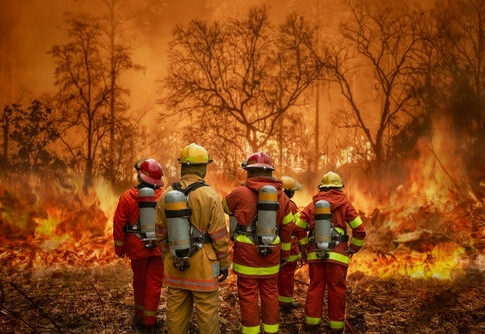
Three firefighters died in a “burnover” on the Colorado‑Utah line, and the way officials explain it is raising hard questions about safety, honesty, and who pays the price when government systems fail.
Story Snapshot
- Three wildland firefighters were killed and two injured in the Snyder Fire along the Colorado‑Utah border.
- Officials call it a “burnover,” but key facts about what went wrong and why are still missing.
- The fire exploded to about 28,000 acres with zero containment, forcing evacuation warnings for nearby communities.
- The tragedy fits a long pattern where agencies praise “bravery” while delaying full accountability for deadly entrapments.
What Happened On The Colorado‑Utah Border
Three firefighters working for the United States Wildland Fire Service and United States Forest Service were killed Saturday while battling fast‑moving wildfires near the Colorado‑Utah border.[2] Two more crew members suffered serious burn injuries and are being treated in the hospital.[2] Officials say the crew was part of an interagency team on the Knowles and Gore fires in Mesa County, Colorado, which merged with other blazes into what is now called the Snyder Fire.[2] The agency has not yet released the names of the fallen firefighters, saying families must be notified first.[5]
The Snyder Fire began as the Snyder Mesa Fire in Grand County, Utah, then crossed the state line and joined the Jones and Knowles fires to form one larger blaze.[1] By Sunday, officials estimated the combined fire had burned about 28,000 acres and was at zero percent containment.[1] Evacuation warnings and pre‑evacuation orders were issued for smaller communities in Mesa County, and several roads were closed as the fire threatened homes and other structures.[3] Residents along the border watched air tankers and ground crews try to slow flames pushed by hot, dry winds.[5]
Inside The “Burnover” That Took Three Lives
The United States Interior Department says the deaths happened during a “burnover,” when flames suddenly spread and close off all escape routes.[2] The firefighters reportedly deployed their emergency fire shelters as the blaze overran their position, a last‑chance survival tool meant to reflect heat and smoke.[2] A burnover is a known type of entrapment in wildland firefighting: crews are caught by rapid changes in fire behavior after escape routes or safety zones are lost or compromised.[15] Officials have not yet shared detailed weather readings, terrain maps, or radio logs from the moment these firefighters were trapped.[1]
Federal guidance on entrapment investigations stresses how critical those missing details are.[14] Investigators are supposed to secure the scene quickly, photograph burn patterns and travel routes from all directions, and gather witness statements within 24 to 72 hours.[14] A proper inquiry looks at wind speed, fuel type, slope, equipment condition, and tactical choices that led to the burnover.[16] Right now, the public narrative focuses on honoring bravery and describing the fire’s size, not on explaining whether escape routes truly failed by chance or by preventable planning errors.[1]
A Deadly Pattern In America’s Wildfire Response
This tragedy is not an isolated event; it fits a long pattern seen since the South Canyon Fire in 1994, where 14 firefighters died in an entrapment on a Colorado hillside.[6] Research on United States wildland firefighter entrapments shows repeated cases where “burnover” or “entrapment” labels are used quickly, often before full forensic review is complete.[18] Studies of these incidents find common issues: unclear escape routes, poor communication, fast weather shifts, and sometimes pressure to keep fighting near valuable property even when conditions turn extreme.[19] Families and frontline crews often wait months or years for clear answers.[18]
New science shows these disasters are not random acts of nature, even in harsh fire seasons.[17] One recent study used machine learning tools to predict firefighter injuries and entrapments with very high accuracy by tracking operational details and risk factors.[17] That kind of analysis suggests fire managers can see danger coming and change tactics sooner. Yet in the Snyder Fire case, there is no public sign so far that advanced risk tools were used or that a clear “stop” line existed where crews would pull back to protect life before property.[2]
Why This Hits Nerves Across The Political Spectrum
Older conservatives and liberals may disagree on climate policy or energy, but many share the sense that the federal government keeps failing ordinary people while protecting itself. In this incident, three public servants died doing dangerous work, yet the first message from officials is a polished phrase—“bravery, dedication, and sacrifice”—instead of a hard accounting of why they were put in that position on that day.[5] That gap feeds the belief that agencies manage narratives, not risks, and that real accountability rarely reaches the top decision makers.
Three firefighters were killed and two others injured on the Knowles and Gore fires near the Colorado-Utah border, as hot, dry winds fueled major wildfire growth https://t.co/jzKQoSbh3z
— FireRescue1 (@FireRescue1) June 28, 2026
Governor Jared Polis declared a disaster emergency and authorized the Colorado National Guard to help with the fires, a move meant to show strong action.[5] Many citizens now ask a deeper question: if we can mobilize troops and aircraft overnight, why do we still send firefighters into known death traps without proven escape routes and real‑time risk tools?[15] When the same kind of entrapment keeps happening over decades, it starts to look less like “tragic fate” and more like a system that chooses acceptable losses—usually borne by people in hard hats, not by those in suits.
What To Watch For Next
In the coming weeks, the key test will be whether agencies release full entrapment investigation reports, including meteorological logs, tactical maps, and crew testimony, instead of hiding behind vague language.[14] Independent safety reviews should make clear whether the Snyder Fire burnover was truly unavoidable or the result of decisions that ignored warning signs from past incidents.[18] For readers across the political spectrum who feel locked out by the so‑called deep state, this case is another chance to see whether government can admit its own failures—or once again bury them under ceremony and polished press releases.
Sources:
[1] Web – 3 firefighters killed, 2 injured while tackling wildfires on the …
[2] Web – Three Firefighters Killed, 2 Injured in Snyder Wildfire on Utah …
[3] Web – 3 firefighters killed responding to Snyder wildfire on Utah-Colorado …
[5] X – Three firefighters died and two were injured while tackling fires on …
[6] Web – Three firefighters killed, 2 injured in Snyder wildfire on Utah …
[14] Web – Three firefighters killed while tackling major wildfires along …
[15] Web – [PDF] Investigating Wildland Fire Entrapments
[16] Web – [PDF] Wildland firefighter entrapment avoidance: modelling evacuation …
[17] Web – Entrapment Investigation & Lessons Learned
[18] Web – Predicting Firefighter Injury and Entrapment in Urban … – PMC – NIH
[19] Web – A review of US wildland firefighter entrapments: trends, important …